APEC 2026: John Lee Outlines Five Key Achievements at Summit; HK Strengthens ASEAN Ties and Expands into Emerging Markets
APEC 2026: John Lee Outlines Five Key Achievements at Summit; HK Strengthens ASEAN Ties and Expands into Emerging Markets
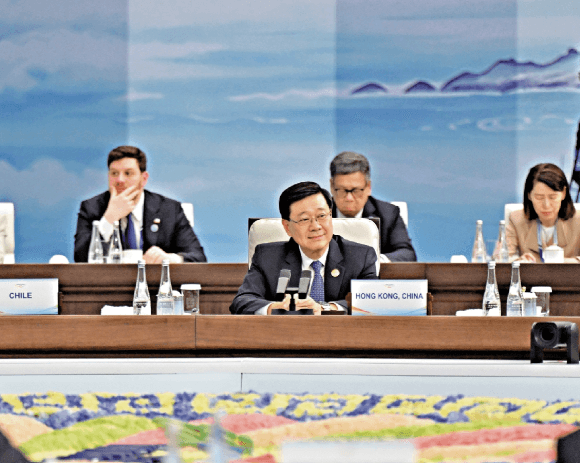
Chief Executive John Lee attended the 33rd Asia-Pacific Economic Cooperation (APEC) Economic Leaders' Meeting in Shenzhen yesterday, exchanging views with leaders of other economies on deepening regional cooperation and expanding into diverse markets. Addressing the meeting, Lee noted that as an international financial, trade, and innovation and technology (I&T) centre, Hong Kong—with the staunch support of the country—will fully leverage its vital roles as a "super connector" and "super value-adder." He pledged that the city will maintain a free and open market, firmly support a rules-based multilateral trading system, expand cooperation within APEC, and continue to contribute to the prosperity of the Asia-Pacific region.
Speaking to the media after the summit, Lee summarized the five key achievements of his attendance. Reaffirming Hong Kong’s steadfast support for free trade and multilateralism, he stated that the city will continue to make good use of the APEC platform to strengthen connectivity with various Asia-Pacific economies. Hong Kong will capitalize on its unique advantage of connecting the Mainland and the world under the "One Country, Two Systems" principle, deepen exchanges and cooperation within the Guangdong-Hong Kong-Macao Greater Bay Area (GBA), and press ahead at full steam with the development of the Northern Metropolis.
During the meeting, Lee remarked that the GBA serves as a crucial platform for regional open cooperation and a driver of high-quality development. The hosting of the APEC Economic Leaders' Meeting in Shenzhen, following the Finance Ministers' Meeting held in Hong Kong for the first time last month, demonstrates the GBA's international influence and competitiveness. In the Global Innovation Index 2026, the "Shenzhen-Hong Kong-Guangzhou" science and technology cluster ranked first globally for the second consecutive year among the world's top 100 clusters, highlighting the fruitful, win-win I&T collaboration among GBA sister cities. Emphasizing that innovation is at the core of future competitiveness, Lee said Hong Kong's world-class universities and research institutions, combined with the GBA's manufacturing and commercial prowess, will jointly drive the commercialization and application of R&D outcomes, while actively promoting the widespread adoption of artificial intelligence to foster high-quality development.
APEC member economies reached a consensus on the Leaders' Declaration and endorsed leader-level deliverable documents covering trade digitalization, the digital economy, emerging technologies, and connectivity. Lee noted that these forward-looking outcomes play a pivotal role in advancing pragmatic cooperation, deepening regional economic integration, and driving high-quality development across the Asia-Pacific.
Largest-Ever HK Delegation
Elaborating on the five achievements after the summit, Lee cited first the contribution of Hong Kong's strengths in actively participating in and supporting the nation's successful hosting of the APEC meetings. For this year's APEC Economic Leaders' Week, Hong Kong sent its largest-ever delegation, including over 50 business leaders who attended the APEC CEO Summit and related events. They engaged directly with business representatives from other economies, fully committing to and supporting the nation's "home-court diplomacy."
Second, deepening exchanges with APEC member economies. Lee pointed out that trade with APEC economies accounts for 87 percent of Hong Kong's total merchandise trade. Through the summit and side events, he held meetings and bilateral talks with leaders of seven economies—Malaysia, Vietnam, Brunei, Thailand, Chile, Peru, and Singapore—forging deeper ties.
Third, consolidating relations with ASEAN member states. Lee stated that the summit provided the opportunity to meet with leaders of five ASEAN member economies. As Hong Kong has been actively seeking early accession to the Regional Comprehensive Economic Partnership (RCEP), the leaders reiterated their continued support. Lee affirmed that Hong Kong is fully prepared to meet and hold discussions with the RCEP Accession Working Group at any time to secure early entry.
Fourth, further expanding into emerging markets. During the week, Hong Kong signed a Working Holiday Scheme agreement with Chile. Being the first such scheme partnered with a Latin American country, it aims to broaden the horizons of Hong Kong youth and foster bilateral ties and friendship. Noting significant growth in trade between Hong Kong and Latin America—with total trade surging 19.1 percent year-on-year last year—Lee added he would hold talks with the leader of Peru to further bilateral exchanges and cooperation.
Helping Asia-Pacific Enterprises Seize GBA Opportunities
Fifth, telling the good stories of the GBA and Hong Kong. Throughout the week, Lee promoted the development opportunities of the GBA and Hong Kong's role to global political and business leaders. He encouraged Asia-Pacific enterprises to use Hong Kong as a springboard into the GBA, connecting them with the region's manufacturing prowess, capital, and vast consumer market, thereby strengthening regional supply chains and jointly building a prosperous Asia-Pacific community.
Lee pledged that Hong Kong will continue to fully leverage its unique advantages of enjoying the strong support of the Motherland and being closely connected to the world under "One Country, Two Systems." The city will deepen international engagement, expand its global cooperation network, and continue to cultivate established markets in Europe, the US, ASEAN, and the Middle East, while tapping into high-potential emerging markets in Central Asia and Africa.
As a long-standing hub for regional economic and trade cooperation and one of the world's most competitive economies, Hong Kong can contribute to strengthening regional cooperation in three ways, Lee said:
First, utilizing the APEC platform to enhance connectivity with different economies, continuing to play the roles of "super connector" and "super value-adder" to promote regional prosperity.
Serving Mainland Enterprises in Expanding Globally
Second, leveraging its unique dual-connectivity advantage under "One Country, Two Systems" to fully advance the development of the "four centres and one hub." Hong Kong will serve as a springboard for the global business community to enter the GBA and Mainland markets, while utilizing a dedicated task force for Mainland enterprises "going global" to assist them in expanding into international markets and maximizing GBA opportunities.
Third, deepening GBA exchanges and cooperation by pressing ahead at full speed with the Northern Metropolis and promoting the synergistic development of the "one zone, two parks" at the Hetao Shenzhen-Hong Kong Science and Technology Innovation Co-operation Zone. Lee concluded that Hong Kong will remain committed to openness, deep integration, and common development with all parties, helping the nation serve as a vital force in leading Asia-Pacific cooperation.