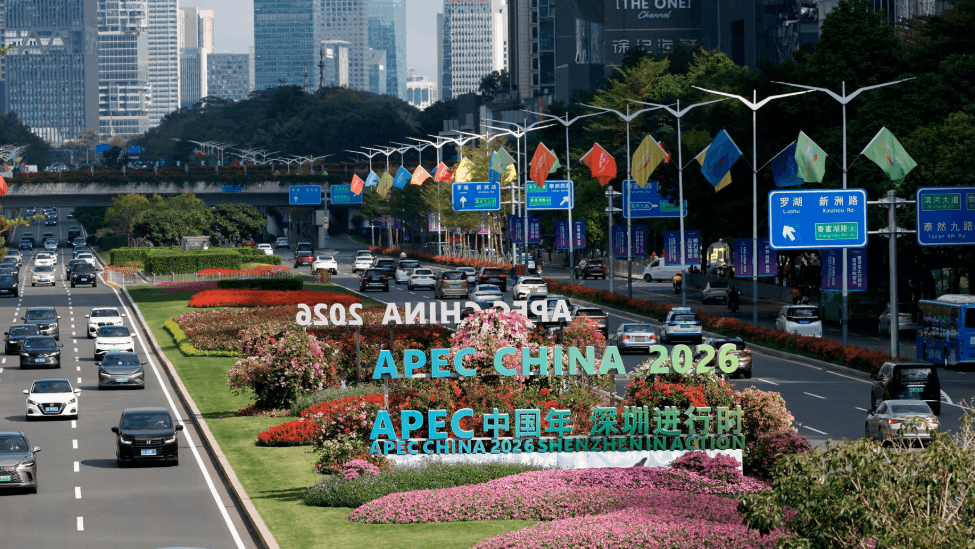
The 33rd Asia-Pacific Economic Cooperation (APEC) Economic Leaders' Meeting and the APEC CEO Summit are set to open in Shenzhen. According to a press briefing on APEC business events held yesterday, leaders from 12 APEC economies and over 2,000 political and business figures will attend the CEO Summit. President Xi Jinping will attend the summit's opening ceremony and deliver a keynote speech, charting the course for Asia-Pacific cooperation under new circumstances. Business representatives attending the summit include executives from 115 Fortune Global 500 companies, covering all 21 APEC economies, alongside renowned enterprises from 13 non-APEC economies. This strong turnout underscores the international community's high expectations for APEC Shenzhen and its firm confidence in the meetings' ability to drive regional economic integration and sci-tech innovation.
Currently, Asia-Pacific regional cooperation stands at a crossroads, with regulatory barriers and the shadow of protectionism still lingering. Shenzhen’s emergence as China’s "third APEC host city" highlights the nation's consistent stance and determination to advance high-level opening-up and share development opportunities with all Asia-Pacific economies. If the Shanghai APEC answered the question of "how China integrates into the world," and the Beijing APEC explored "how the Asia-Pacific moves toward integration," then today’s Shenzhen APEC is dedicated to building tangible "technological interfaces" and "regulatory solutions" for regional cooperation.
Shenzhen’s development journey is in itself the best exemplar of APEC’s core focus on "openness, innovation, and cooperation." Ta Kung Pao today publishes a special feature titled "Why Shenzhen," offering an in-depth look at the city's "miraculous journey" from a sleepy fishing village into a modern international metropolis. The city has evolved from the emergence of the first "10,000-yuan households" in Luohu's Fishing Village to the iconic "Shenzhen Speed"—building one story every three days at the International Trade Center. It has seen tech giants born out of one-meter counters in Huaqiangbei, Nanshan District joining the "trillion-yuan GDP club," and the vibrant institutional innovations now taking shape in the Qianhai Cooperation Zone. The westward trajectory of Shenzhen’s urban center, shifting five times over the decades, vividly illustrates the tremendous synergy of reform, innovation, and opening-up.
The inspiration Shenzhen offers the world goes beyond rapid economic growth; it provides a living urban model of Chinese modernization. From establishing the China Center for Promoting APEC Cross-Border Data Flow Cooperation in Qianhai, to valuable pilot initiatives such as the "negative list" and "regulatory sandboxes," these practices are being transformed into "Chinese standards" and public goods that can be adopted across the Asia-Pacific. Meanwhile, Shenzhen’s development is not solely driven by GDP. Instead, it adheres to green development and inclusive growth. This governance experience of balancing speed with quality offers valuable lessons for many developing economies in the region.
While the main events of the APEC gathering take place in Shenzhen, the true "home turf" is the entire Guangdong-Hong Kong-Macao Greater Bay Area (GBA). Behind Shenzhen’s development miracle beats the constant pulse of Shenzhen-Hong Kong integration. Over 40 years ago, the Lo Wu Bridge served as the physical link between the two cities. Today, the cross-border flow of research elements in the Hetao Shenzhen-Hong Kong Science and Technology Innovation Cooperation Zone, the "five-minute customs clearance" at the new Huanggang Port, and the seamless connection of the Shenzhen-Hong Kong Cross-Border Data Verification Platform have turned invisible data flows and innovation chains into the "Lo Wu Bridge" of the new era. The increasingly mature collaborative model—combining Hong Kong's basic research, Shenzhen's pilot testing and incubation, and the GBA's mass production—vividly demonstrates the strong vitality of "One Country, Two Systems." Integration is not about making both sides identical, but about allowing distinct institutional advantages to connect seamlessly and operate efficiently.
In this year's APEC gathering, Hong Kong is both a key participant and a beneficiary of major development opportunities. The APEC Finance Ministers' Meeting, successfully held in Hong Kong last month, showcased to the world the city's status as an international financial center and its unique advantage of connecting the Mainland with the rest of the world. This summit also features a dedicated panel session on the Greater Bay Area, amplifying the region's magnetic appeal and forging a new chapter of cooperation. All sectors in Hong Kong should seize this opportunity and build on the momentum to strengthen both "hard and soft connectivity" in areas such as cross-border data flow, sci-tech commercialization, and regulatory alignment, jointly building the GBA into the most dynamic innovation hub and growth pole in the Asia-Pacific.
The landmark stone that once stood on the mudflats of Qianhai—envisioning "painting a masterpiece on a blank sheet of paper"—now bears witness to the grand development of the Greater Bay Area and its surging influence across the Pacific. The Asia-Pacific consensus forged during APEC's "Shenzhen Time" is certain to inject strong stability and positive energy into a turbulent and changing world. Moving forward hand in hand, the Greater Bay Area is bound to write an even more glorious chapter in serving the nation's overall development and promoting common prosperity across the Asia-Pacific.