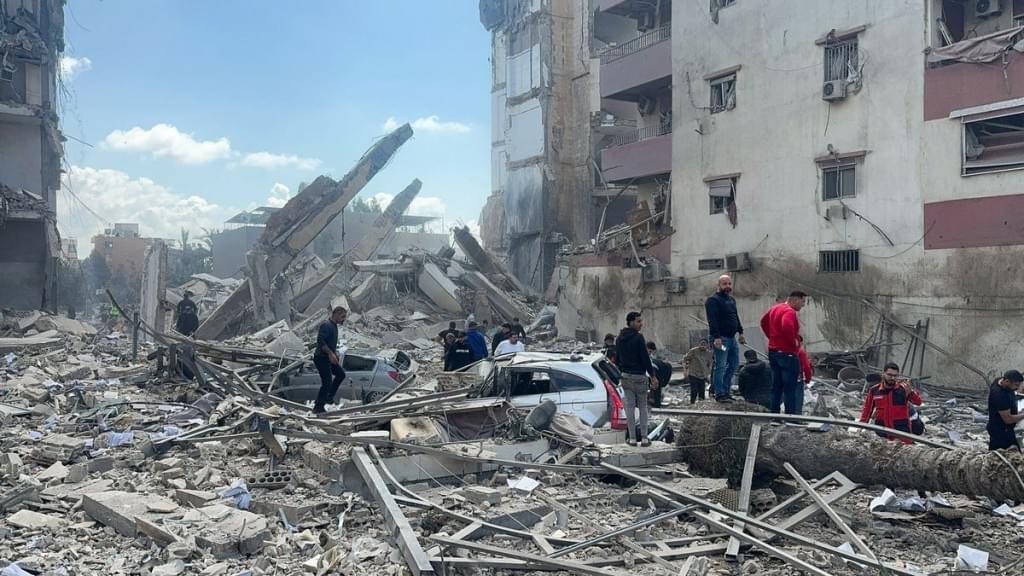
Israel carried out its heaviest airstrikes on Lebanon since the conflict with Hezbollah erupted last month, killing at least 182 people on Wednesday, according to Lebanon’s health ministry.
The attacks came shortly after Hezbollah paused its operations in line with a two-week U.S.-Iran ceasefire, raising serious questions about the fragile truce. Iranian President Masoud Pezeshkian had described a ceasefire in Lebanon as an essential condition for Iran’s agreement with Washington.
Israel’s military said it conducted its largest coordinated strike of the war, hitting more than 100 Hezbollah command centres and military sites across Beirut, the Bekaa Valley, and southern Lebanon within ten minutes. At least five consecutive strikes rocked central Beirut, sending columns of smoke over the capital.
Lebanon’s civil defence reported a higher toll of 254 killed and over 1,100 wounded, with 91 deaths in Beirut alone. The health ministry’s figure of 182 dead was not final.
It was the bloodiest day since the war began on March 2, when Hezbollah fired rockets into Israel in support of Iran following a U.S.-Israeli strike on Iranian targets.
UN Human Rights Chief Volker Türk condemned the “horrific” scale of destruction, saying the carnage “defies belief” just hours after the U.S.-Iran ceasefire was announced.
Israeli Prime Minister Benjamin Netanyahu stated in a televised address that Lebanon was not included in the truce with Iran and that strikes on Hezbollah would continue. The White House and U.S. Vice President JD Vance confirmed the same position, attributing Iran’s expectations to a “misunderstanding.”
Hezbollah condemned the attacks as “barbaric aggression” and warned of repercussions. Senior figures claimed the group had halted operations after being told it was covered by the ceasefire.
The strikes hit civilian areas in Beirut and southern Lebanon. Israel also destroyed the last bridge linking southern Lebanon to the rest of the country. More than 1.2 million people have already been displaced by the fighting, with many hoping for a ceasefire that would allow them to return home.
Before Wednesday’s attacks, over 1,500 people had been killed in Lebanon since the war began, including more than 130 children.