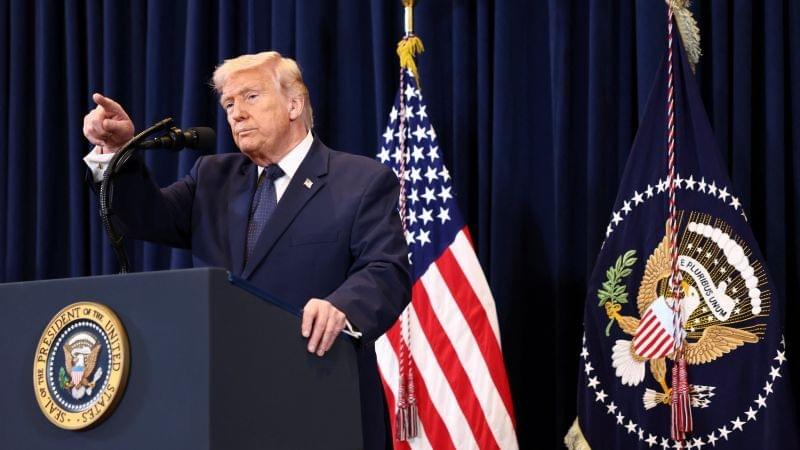
U.S. President Donald Trump announced on Tuesday that the United States had agreed to a two-week ceasefire with Iran, just hours before a self-imposed deadline that had threatened widespread destruction of Iranian infrastructure.
In a post on his Truth Social platform, Trump stated that the ceasefire was conditional on Iran agreeing to the "complete, immediate, and safe opening" of the Strait of Hormuz, a vital waterway through which about one-fifth of global oil shipments typically pass. He described the agreement as a "double-sided ceasefire," noting that the U.S. had already met and exceeded its military objectives and was making progress toward a long-term peace deal in the Middle East.
The announcement marked a sharp reversal from earlier in the day, when Trump had issued a stark warning on Truth Social. He threatened that if Iran failed to reach an agreement by his 8 p.m. EDT deadline, "a whole civilization will die tonight, never to be brought back again." He added, "I don't want that to happen, but it probably will," while suggesting that a regime change might pave the way for "something revolutionarily wonderful."
Trump credited the last-minute deal to mediation by Pakistan, saying it followed conversations with Pakistani Prime Minister Shehbaz Sharif and Army Chief Gen. Asim Munir. He noted that Iran had presented a 10-point proposal, which he called a "workable basis" for negotiations. The two-week period, he said, would allow the sides to finalize and consummate a broader agreement. Talks between the U.S. and Iran are scheduled to begin on Friday in Islamabad, Pakistan.
Vice President JD Vance, speaking earlier on Tuesday, indicated that the U.S. had largely accomplished its military objectives in Iran. He expressed confidence that Iran would respond to the deadline and suggested the conflict would end soon.
The ceasefire announcement came amid intensified U.S. and Israeli strikes on Iranian targets. Earlier on Tuesday, U.S. forces attacked more than 50 military sites on Kharg Island, Iran's key oil export hub off the southern coast, though critical oil and gas infrastructure was not targeted. Strikes also hit bridges, an airport, and other facilities.
Iran's Supreme National Security Council confirmed acceptance of the two-week ceasefire but emphasized that it did not end the war. Iranian state media portrayed the U.S. move as a "humiliating retreat." Iran's foreign minister indicated that safe passage through the Strait of Hormuz would be coordinated by Iranian forces during the ceasefire period, subject to technical limitations.
Israel also agreed to the ceasefire and suspended its bombing campaign, though the Israeli military reported detecting missiles launched from Iran shortly after Trump's announcement.
The six-week-old conflict has resulted in more than 5,000 deaths across nearly a dozen countries, including over 1,600 civilians in Iran, according to government and human rights sources. Iran's closure of the Strait of Hormuz has driven up global oil prices, raising fears of an economic downturn.
Trump's earlier threats to destroy bridges and power plants in Iran had drawn international condemnation, including from the United Nations and Pope Leo, and rattled financial and energy markets.
The abrupt de-escalation occurs as Trump's approval ratings have reached historic lows amid the war and rising gasoline costs, with the U.S. midterm elections approaching. Polls show strong American opposition to the conflict.