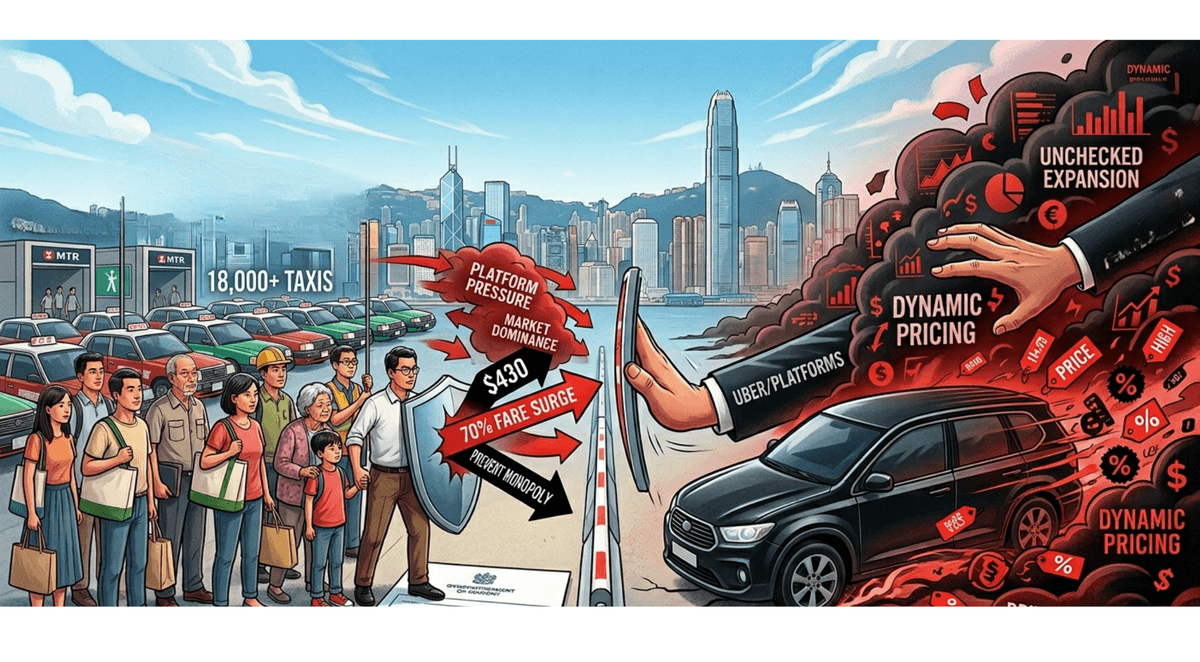
The Hong Kong government is actively developing a regulatory framework for ride-hailing services, planning to invite platform licence applications in the third quarter. At this critical stage, the focus should remain on commuter interests, road capacity, and long-term industry sustainability — advancing steadily and cautiously.
Yet senior executives of Uber have recently voiced “concerns” over proposals to cap vehicle permits at 10,000–15,000. They warned of a “50% drop in active drivers”, “70% fare surges during peak hours”, and even cited extreme cases like “a Disneyland to Wan Chai trip costing $430”, clearly aiming to generate anxiety and pressure the government.
Platforms Claim to Serve the Public, But Seek Market Dominance
Ride-hailing platforms can offer an additional travel option, but their core business is pursuing scale and control. When they push for relaxed quotas under the guise of “insufficient supply”, the real goal is often market expansion. Once dominant, they gain pricing power and rule-making authority. Dynamic pricing, initially for emergencies, could become the norm, driving up costs for commuters.
Platform monopolies rarely benefit both passengers and drivers. As platforms grow, they can sharply adjust fares during peak times or bad weather, while drivers face higher commissions, stricter rules, and lower real income. Passengers pay more, drivers earn less, and platforms reap the profits.
Hong Kong’s Limited Roads Demand Cautious Regulation
Hong Kong is a dense, high-traffic city with a well-developed public transport system. Any new point-to-point services will affect congestion, pick-up/drop-off order, enforcement, and insurance. Setting an upper limit on licences is responsible governance — it prevents risks rather than being “outdated” or “against international norms”.
The suggested 10,000–15,000 cap is a balanced approach based on local conditions. It allows orderly entry while avoiding excessive supply that could overwhelm roads. With around 18,000 metered taxis providing price stability, a reasonable quota enables healthy competition between ride-hailing and taxis, benefiting service quality and overall market balance.
Extreme Scare Tactics Should Not Drive Policy
Uber’s “$430 fare” example uses isolated peak scenarios to create panic and push for larger quotas. In reality, Hong Kong has diverse options — MTR, buses, and taxis — to handle demand. With sound regulation and multiple providers, platforms cannot easily manipulate prices.
Public discussion should not be dictated by worst-case scenarios from individual platforms. The government must hold firm. The right path is gradual, regulated introduction with clear caps, regular reviews, and stronger measures on driver protection, insurance, transparency, and anti-monopoly rules.
Uphold People-First Governance and Prevent Monopoly
Hong Kong needs regulated competition, not unchecked expansion. A gradual, quota-controlled, and regularly reviewed approach best protects commuters, maintains road order, and safeguards drivers’ livelihoods. Facing alarmist pressure, the HKSAR Government must stand firm, use systems to guard against monopoly risks, and ensure the point-to-point transport market does not fall into a single platform’s hands — preventing citizens from becoming the ones exploited.