U.S. Nobel Chemistry Laureate Omar Yaghi Joins Tsinghua University as Full-Time Chair Professor
U.S. Nobel Chemistry Laureate Omar Yaghi Joins Tsinghua University as Full-Time Chair Professor
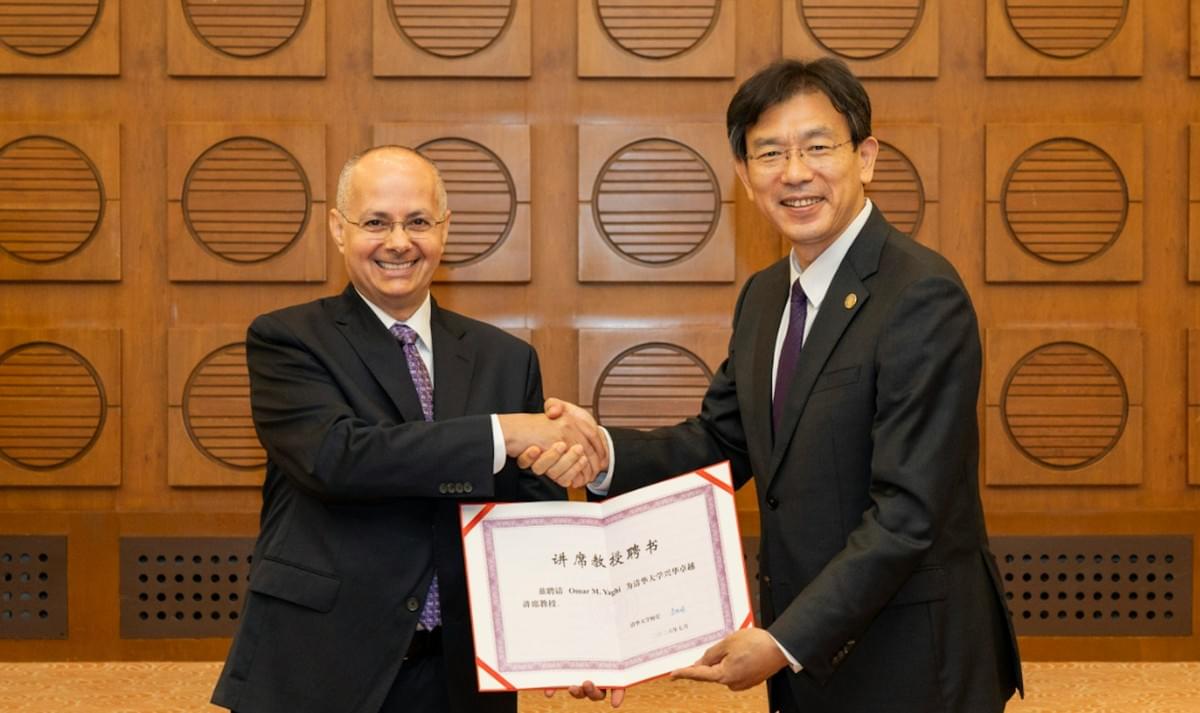
Tsinghua University held an appointment ceremony on July 3 for Professor Omar Yaghi as the Yaghi Chair Professor. Tsinghua University Party Secretary Qiu Yong and President Li Luming attended the event.
President Li Luming stated that Professor Yaghi is a world-leading chemist in the field of chemical materials with deep ties to Tsinghua University. He expressed hope that Yaghi’s arrival would inject strong momentum into the high-quality development of Tsinghua’s chemistry discipline for its next century, promote interdisciplinary collaboration on cutting-edge research, and contribute to Tsinghua’s advancement among the world’s leading universities.
In response, Professor Yaghi said he would embark on a new chapter in research and education with renewed enthusiasm and greater ambition. He looks forward to working with Tsinghua colleagues to address the challenges of the era, push the boundaries of knowledge, and deliver innovative achievements that serve the world.
Professor Omar Yaghi previously served as a Chair Professor in the Department of Chemistry at the University of California, Berkeley. In 2025, he was awarded the Nobel Prize in Chemistry jointly with Richard Robson and Susumu Kitagawa for their pioneering contributions to the field of metal-organic frameworks (MOFs).
Yaghi was appointed Honorary Professor at Tsinghua University in 2022 and has now taken up a full-time faculty position.
According to a report by *Guangming Daily*, Yaghi’s research encompasses the synthesis, structure, and properties of inorganic and organic compounds, as well as the design and construction of novel crystalline materials. His “building block” approach has enabled exponential growth in the creation of new materials, generating unprecedented chemical diversity. He pioneered the development of metal-organic frameworks (MOFs), covalent organic frameworks (COFs), and molecular weaving, and was the first to define the new field of “reticular chemistry.”